
ASTM E1687 vs Standard Ames Testing: Which Method Is Right for Your Base Oil?
Why Virgin Base Oil Safety Assessment Matters
Virgin base oils that are used to formulate metalworking fluids (MWFs) are often evaluated as part of occupational safety, and product stewardship by health-and-safety regulatory bodies such as Occupational Safety and Health Administration (OSHA). Most notably passing specific carcinogenicity and toxicity testing is generally required to be deemed as safe for industrial worker exposure.
The virgin base oil, a high-quality lubricant base, may contain polycyclic aromatic compounds (PACs) which are historically associated with dermal cancer. Repeated occupational exposure to the MWFs, thus, may result in exposure of the workers to these carcinogenic compounds. Therefore, base oils must be severely refined and rigorously tested as part of product stewardship and worker safety due diligence.
Why Standard Ames Testing Can Be Challenging for Petroleum-Derived Oils
The OSHA guidelines recommend the use of a modified Ames assay as per ASTM E1687. ASTM E1687 is a screening technique to detect the presence of potential dermal carcinogens in virgin base oils used in the formulation of metalworking oils. This assay is a Salmonella-based microbiological test with specific modifications that improves its sensitivity to PAC-associated mutagenesis.
The traditional Ames test can sometimes yield false negatives for heavy petroleum fractions because the complex oil matrix limits bacterial exposure or interferes with assay performance. The ASTM E1687-based modified version uses a specific solvent extraction step, wherein dimethyl sulfoxide (DMSO) is used to concentrate the PACs, which improves the test's sensitivity and reliability for oil samples.
Standard Ames vs ASTM E1687: Method-Selection Guide
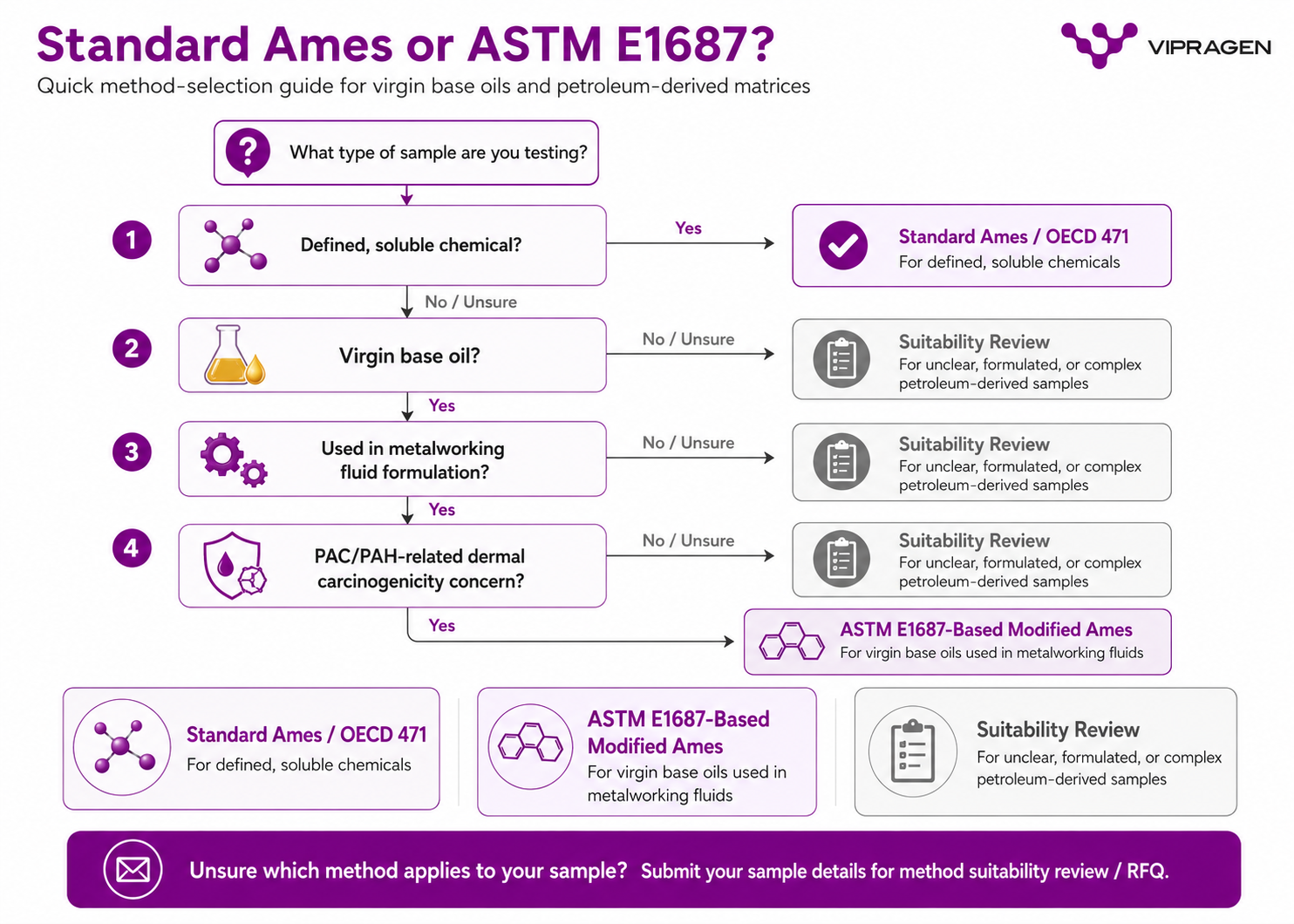
ASTM E1687 is not meant to replace the traditional Ames test in every situation. The right method depends on the nature of the test sample, its intended application, matrix complexity, and the safety question being asked. For example, a defined and soluble chemical may be suitable for Standard Ames testing, while a virgin base oil intended for metalworking fluid formulation may require an ASTM E1687-based Modified Ames approach.
To make the selection clearer, the decision matrix below provides a quick method-selection guide for determining when Standard Ames testing, ASTM E1687-based Modified Ames testing, or if a suitability review may be more appropriate.
Why Testing Partner Selection Matters
ASTM E1687 specifically notes that the test should be performed by personnel who are well versed in the Ames test and familiar with the physical and chemical properties of petroleum products. This is important because virgin base oils are not simple soluble chemicals. Their matrix behaviour, cytotoxicity profile, and metabolic activation requirements can directly affect the performance and interpretation of the test.
At Vipragen Biosciences, our genotoxicity team has extensive experience conducting Ames-based studies, including Standard Ames, Modified Ames, and Enhanced Ames test designs. We also have prior experience supporting similar complex petroleum-derived industrial oil matrix studies.
Vipragen brings this expertise along with a GLP-certified toxicology infrastructure, experienced study personnel, and fit-for-purpose study design.
Need to Determine the Right Ames-Based Method for Your Sample?
For complex petroleum-derived industrial oil bases, choosing the right test design early can help avoid unclear results, repeat testing, and delays in customer qualification or internal safety review.
Vipragen Biosciences can help you evaluate whether Standard Ames testing or ASTM E1687-based Modified Ames testing is more suitable for your safety assessment requirement.
Our team can support you with:
» Method suitability review based on your sample type and intended application;
» Standard Ames, Modified Ames, and Enhanced Ames testing;
» ASTM E1687-based testing strategies for virgin base oils;
» GLP-certified toxicology infrastructure;
» Scientifically defensible study design, execution, interpretation, and reporting.
Submit Your Sample Details for Review
Email your sample details to: bd@vipragen.com and we will help you identify the appropriate Ames-based testing approach for your requirement.