
Building the Safety Evidence for GRAS: What Non-Clinical Studies May Be Needed?
Building the Safety Evidence for GRAS: What Non-Clinical Studies May Be Needed?
GRAS, standing for Generally Recognized as Safe, is a conclusion that a substance's use in food is safe, based on the standard set out in 21 CFR §170.30 (and underlying FD&C Act provisions), typically documented/submitted to FDA via the voluntary GRAS Notification procedures in 21 CFR Part 170, Subpart E (§170.203–170.285). The FDA Redbook 2000 provides toxicological testing guidance that can supply the scientific evidence supporting that conclusion, but it isn't itself a regulatory source of the GRAS determination.
It is used to establish the safety of an ingredient under its intended conditions of use, including the quantity to be used, the proposed use, dietary exposure and its potential hazards.
For most novel food ingredients entering the US market, GRAS status needs to be established through scientific procedures based on the generally available and accepted scientific evidence.
And while there is no single battery of studies applicable for scientifically evaluating the safety of every novel ingredient, a GRAS safety assessment will generally include a combination of the following studies:
Genotoxicity Studies
Genotoxicity testing identifies DNA-damaging compounds and potential human carcinogens using a standard battery of in-vitro and in-vivo tests. Depending on the available evidence and characteristics of the test material, the programme may include:
- » Bacterial reverse mutation testing (Ames test),
- » In-vitro mammalian-cell genotoxicity testing (Chromosomal Aberration Assay and In-vitro Micronucleus Assay), and
- » In-vivo Micronucleus Assay, where scientifically warranted
Dose-Range-Finding or 28-Day Repeat Dose Toxicity Studies
Dose-range-finding or 28 -Day Repeat Dose Toxicity studies, are preliminary toxicology studies used to assess the tolerability and to determine the appropriate dose levels of the test material for the subsequent 90–day repeat-dose studies.
The above studies play an important role when adequate prior information on tolerability and appropriate doses is not available. These studies aim to provide information on:
- » Systemic toxicity
- » Target organs
- » Dose-response relationships
- » Clinical pathology changes
- » Histopathological findings
90-Day Sub-chronic Oral Toxicity
A 90-day sub-chronic oral toxicity study evaluates the cumulative toxic effects of a test material that is administered daily for over 90 days, including recovery for 28 days.
Such studies can provide a comprehensive assessment of repeated systemic exposure, support establishment of a No-Observed-Adverse-Effect Level (NOAEL), and determine safe human intake levels
Other Targeted Safety Studies
Additional studies may sometimes be required when specific safety questions remain.
Depending on the ingredient, these could include assessments related to:
- » Reproductive or developmental toxicity are required based on the exposure, systemic toxicity intended population such as pregnant or lactating women.
- » Allergenicity are required for protein / peptide / allergically derived ingredients.
- » Toxicokinetics / exposure assessment studies especially for novel chemicals, wherever required based on the scientific evidence.
- » Specific organ-system effects
- » Other ingredient-specific concerns identified from the literature or manufacturing process
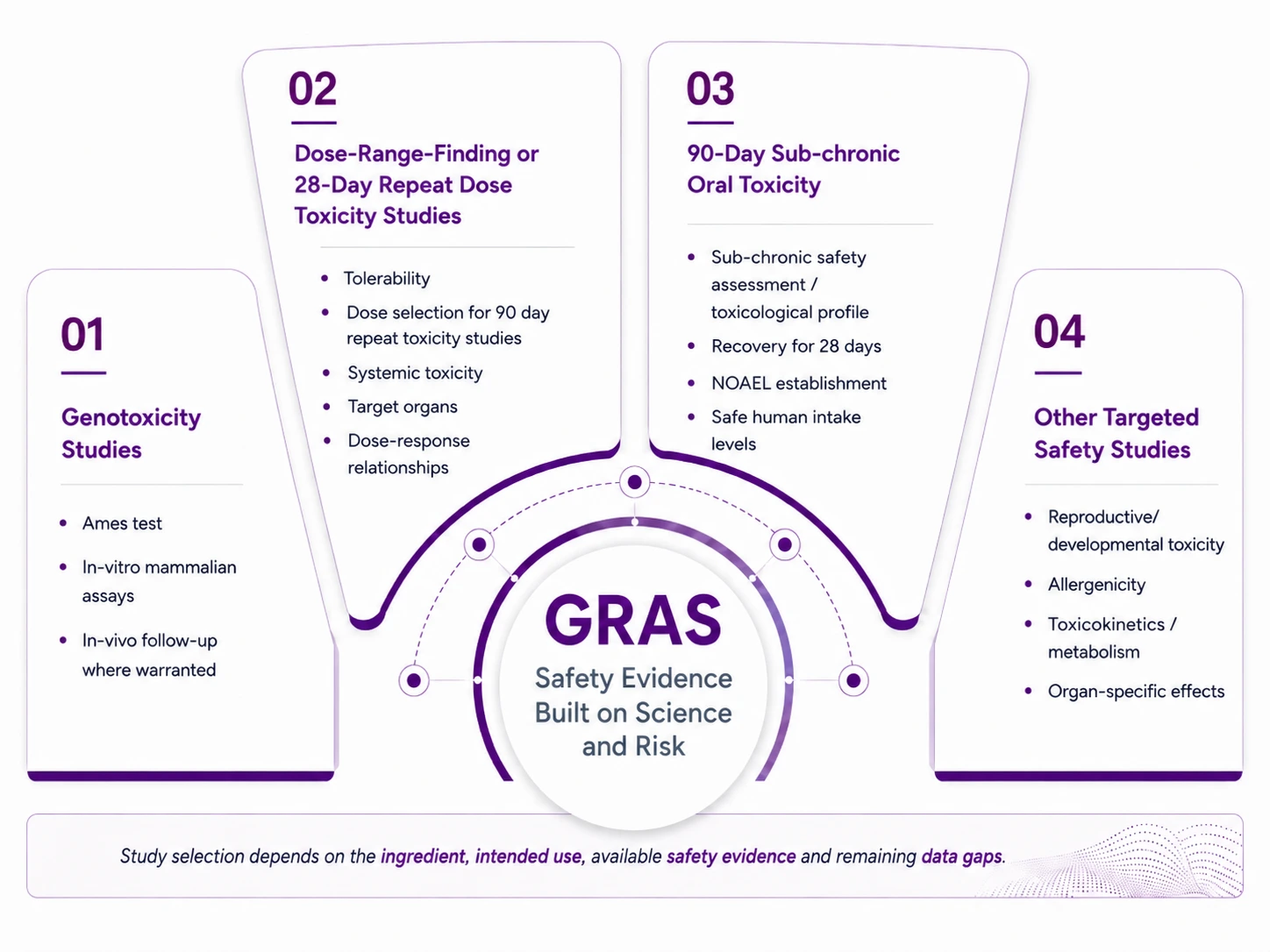
The overall selection of studies required for a GRAS programme is therefore, risk-driven rather than checklist-driven, generally beginning with the evaluation of the available evidence and remaining data gaps before individual toxicology studies are selected.
The additional nonclinical studies are, therefore, carried out to address those gaps and strengthen the scientific basis for concluding that the ingredient is safe under its intended conditions of use.
For instance, a well-characterized ingredient with substantial published toxicology studies, human safety data, history of food use, information on related ingredients, and previous regulatory assessments, may require only limited additional testing.
Whereas, a novel ingredient with limited history of use or insufficient toxicological information may require a more extensive programme.
Where Vipragen Biosciences Can Support GRAS Safety Programmes
Vipragen Biosciences supports food and functional ingredient developers with nonclinical safety studies that can contribute to GRAS safety assessments.
Our team can support you with:
- » Genotoxicity studies
- » Dose-range-finding studies or Repeat-dose oral toxicity studies
- » 90-day subchronic toxicity studies
- » Toxicokinetics and bioanalytical support
- » Clinical pathology and histopathology
- » Analytical support studies
- » Integrated non-clinical safety programmes
Submit Your Query for a GRAS Safety Programme
Email your query to: bd@vipragen.com and we will help you identify the appropriate battery of safety required for your GRAS evaluation.