
Which CAR-T candidate should you advance into in vivo studies?
An Approach Informed by FDA Guidance.
Not every CAR-T candidate that kills tumour cells should move forward.
The real challenge is to identify candidates that are most likely to succeed in vivo.
Therefore, early-stage CAR-T candidate evaluation generally involves examining three important dimensions of CAR-T’s therapeutic pathway: mechanism of action, target specificity and functional persistence.
For instance, the FDA Guidance document for CAR-T products, 2024 Considerations for the Development of CAR T Cell Products final guidance, recommends that non-clinical evaluation focus on characterising CAR specificity, antigen-dependent cytolysis and cytokine secretion, antigen sensitivity, proliferation, target-expression profile, and risks such as uncontrolled proliferation or clonality.
Together, these assessments provide a strong basis for comparing candidates, identifying potential liabilities and selecting candidates for progression into in vivo studies.
1. Mechanism and Functional Potency:
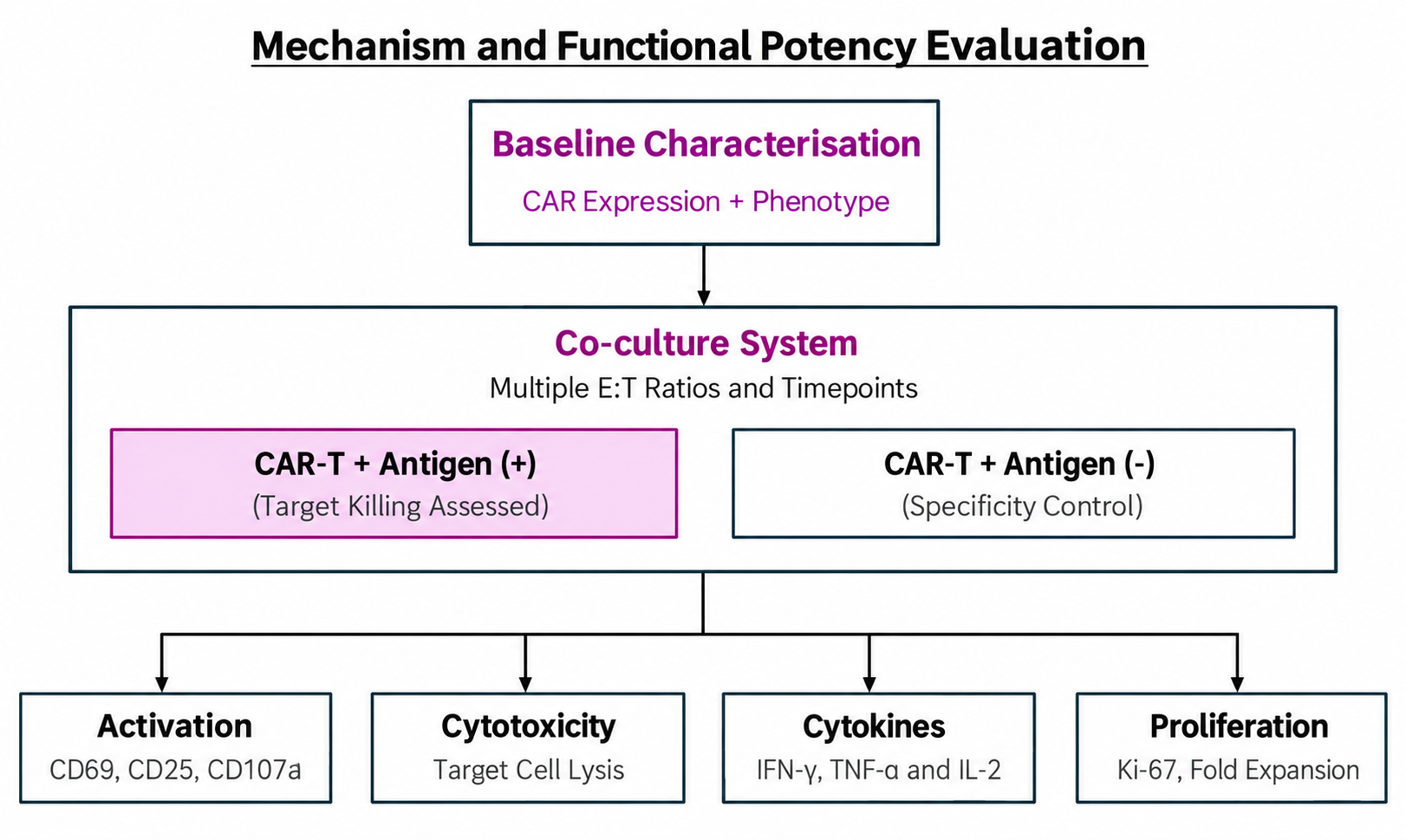
Establishing that a CAR-T candidate works as intended is the foundation for everything that follows. An integrated functional evaluation can combine CAR-T characterization with antigen-dependent co-culture assays, across multiple effector-to-target (E:T) ratios and time points, with readouts that may include:
- CAR Expression and Cellular Phenotype can be characterized by flow cytometry, including the % of CAR-positive cells and their expression levels, and the relevant T-cell subsets.
- Additional phenotypic characterization which may include assessment of memory-associated subsets (TSCM, TCM, TEM) and differentiation status, which are increasingly recognized as predictors of CAR-T persistence and therapeutic durability.
- Activation and Degranulation can be assessed with flow-cytometric markers such as CD69 and CD25 for activation and CD107a for degranulation.
- Target-Specific Cytotoxicity can be quantified using flow cytometry, luciferase reporter assays or real-time cell analysis.
- Secretion of Cytokines such as IFN-γ, TNF-α and IL-2 can be evaluated using ELISA or multiplex cytokine analysis.
- Proliferation and Expansion can be assessed using cell-proliferation dyes, Ki-67 expression, absolute cell counts or fold-expansion measurements.
2. Specificity and Antigen Sensitivity:
For CAR-T, potency of a candidate should be complemented with high selectivity for its target antigen.
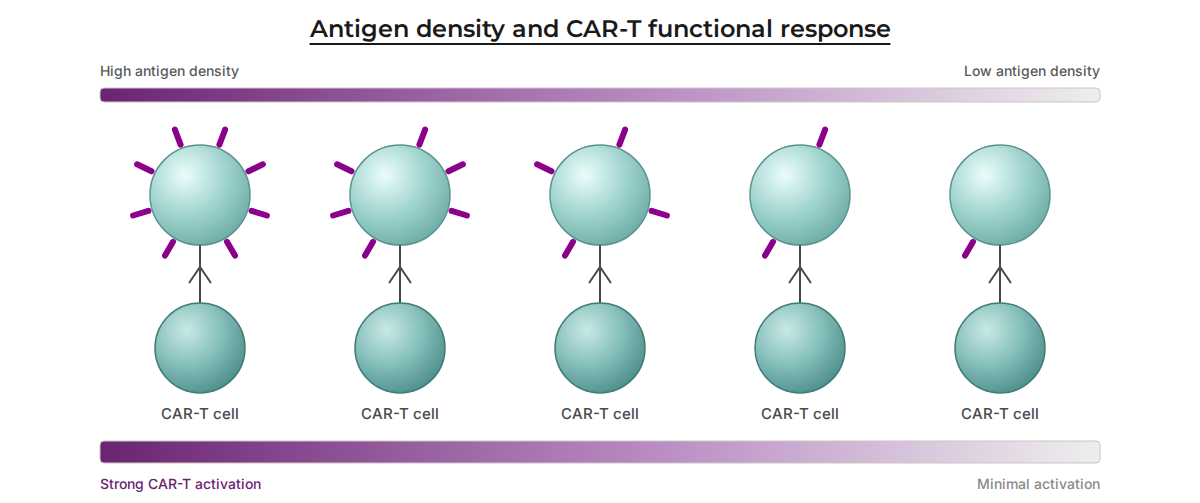
As mentioned earlier, CAR-T specificity can be examined by co-culturing with antigen-positive and antigen-negative target cells to confirm antigen-dependent activity.
Testing with target cells carrying different levels of antigen density can help characterize the antigen-density threshold required for CAR activation, proliferation, and target lysis. This is particularly important when a target antigen is expressed heterogeneously within tumours or at lower levels in normal tissues (potential on-target/off-tumour activity). This approach can help distinguish candidates with a more favourable specificity profile.
Specificity assessment should also consider both off-target activity / cross-reactivity and on-target/off-tumour effects, particularly for antigens expressed at low levels on normal tissues.
3. Functional Persistence Under Repeated Antigen Exposure:
The long-term success of ex vivo CAR-T cell therapy depends heavily on its persistence and function after reinfusion into the patient. This is particularly important for candidates targeting solid tumours where persistent antigen stimulation can lead to T cell exhaustion, treatment resistance and relapse. Hence, assessing functional persistence is essential for selecting a suitable CAR-T candidate that can progress to in vivo studies.
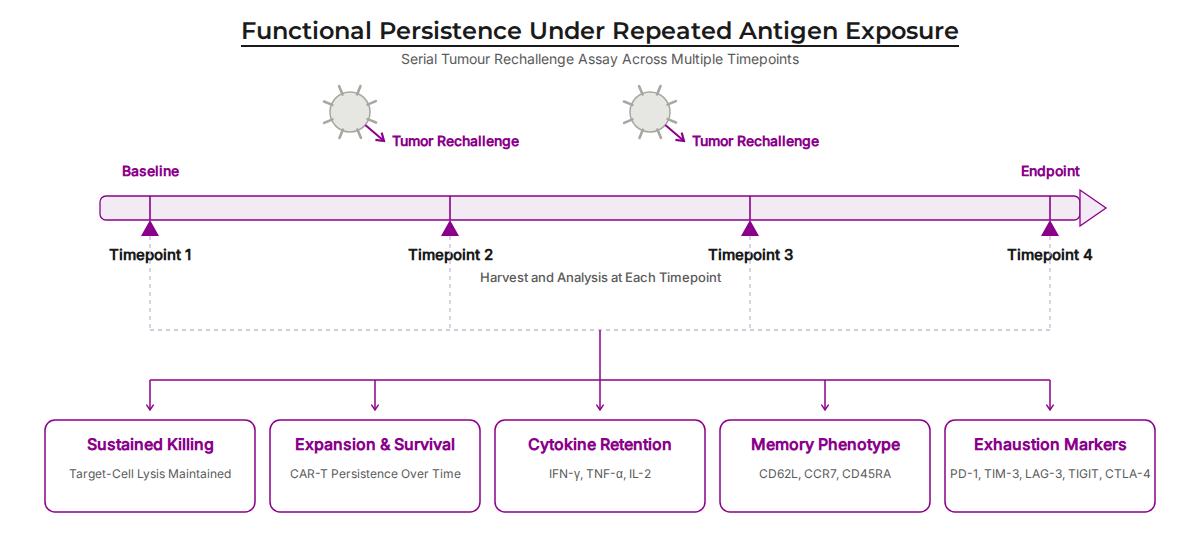
At the in vitro level, repeated antigen-challenge or serial tumour-stimulation assay is used to evaluate the functional persistence of CAR-T cells with key readouts that may include:
- Sustained target-cell killing
- CAR-T expansion and survival
- retention of cytokine secretion (IFN-γ, TNF-α, and IL-2)
- memory and differentiation phenotype (CD62L, CCR7, and CD45RA)
- Functional exhaustion or dysfunction (PD-1, TIM-3, LAG-3, TIGIT, and CTLA-4)
- Evaluation of metabolic fitness and polyfunctional cytokine responses, which can influence long-term antitumour activity.
Candidate Selection and Progression
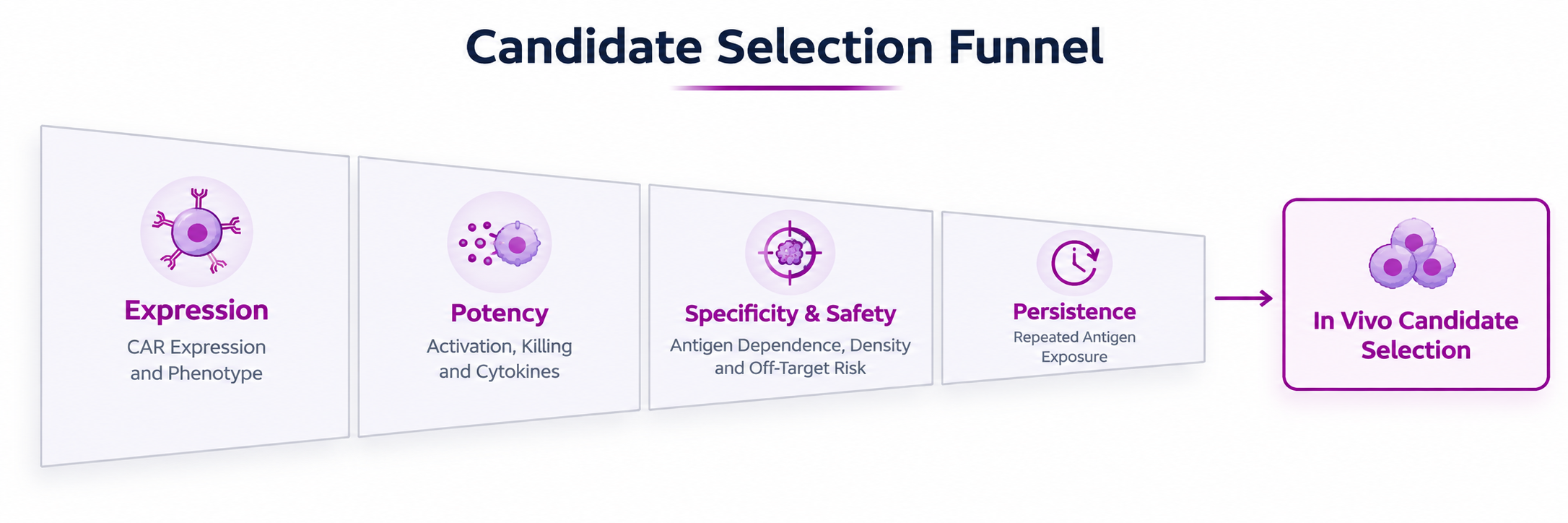
Candidates can be scored across mechanism, specificity and persistence. For example, a candidate with strong early killing but rapid exhaustion, or activity only at high antigen density, may rank below one with moderate but durable and antigen-specific activity. These characteristics may help identify candidates that are better positioned for progression into in vivo studies.
Importantly, candidate selection should balance efficacy-related attributes with potential safety liabilities, including off-target activity, uncontrolled proliferation, and on-target/off-tumour effects.
Vipragen Biosciences supports CAR-T and CAR-NK developers through integrated in vitro functional characterization, in vivo efficacy evaluation and translational safety assessment.
If you're evaluating CAR-T or CAR-NK candidates for progression into in vivo studies, send us an email at bd@vipragen.com with your target, development stage and expected timeline to discuss study scope and receive a quotation.
#CART #CARNK #FDA #DrugDiscovery #CellTherapy #PreclinicalResearch